
This was a tender port and we had again booked a tour with Blue Puffin. Took a walk around the small fishing port, as we managed to get a very early tender. It is only two parallel streets, with a few cafes, small shops, with the odd piece of artwork and quaint colorful houses that overlook the Barents Sea.
Our first visit was on Magerøya island (Meagre Island) to Kamøyvær known for its small cod fishing fleet, harbor, and fish processing plants. Cod is line caught, filleted and hung to dry and is considered a delicacy both in Norway and worldwide. Our guide Monika has her house here, which she bought in 2013 for €20k, as it was in need of some renovation. This is still ongoing, but the skilled workmen are few and far between, she is on the wait list for renovations next year!
Next stop was Skarsvåg where we saw the infamous Red King Crab (or Alaskan King Crab), a delicacy here. In the 1960s, Soviet scientists transplanted thousands of the crabs and as so happens with playing god with ecosystems, things did not go as planned. The crabs did very well, growing enormously both in size and number, which some people have benefited from the invasion, they are ecologically destructive and threaten the North Atlantic cod fishery, as the crab eat the cod fish eggs and everything else.
Saw a number of reindeer on the way all domesticated and owned by the local Sami tribed, we also stopped to see a traditional Sami with his Reindeer at the side of the road.
Then to where the Atlantic Ocean meets the Arctic Ocean at the North Cape, a place so far north only the Svalbard archipelago sits between it and the North Pole.
It first became famous in 1553 when Richard Chancellor, an English explorer, discovered it while attempting to find a sea route through the Northeast Passage. In 1664 the first tourist visited the North Cape plateau. He was an Italian priest named Francesco Negri, followed by a number of others including King Chulalongkorn from Thailand (the King and I), King Oscar II of Sweden and Thomas Cook started tours to this site in 1875,
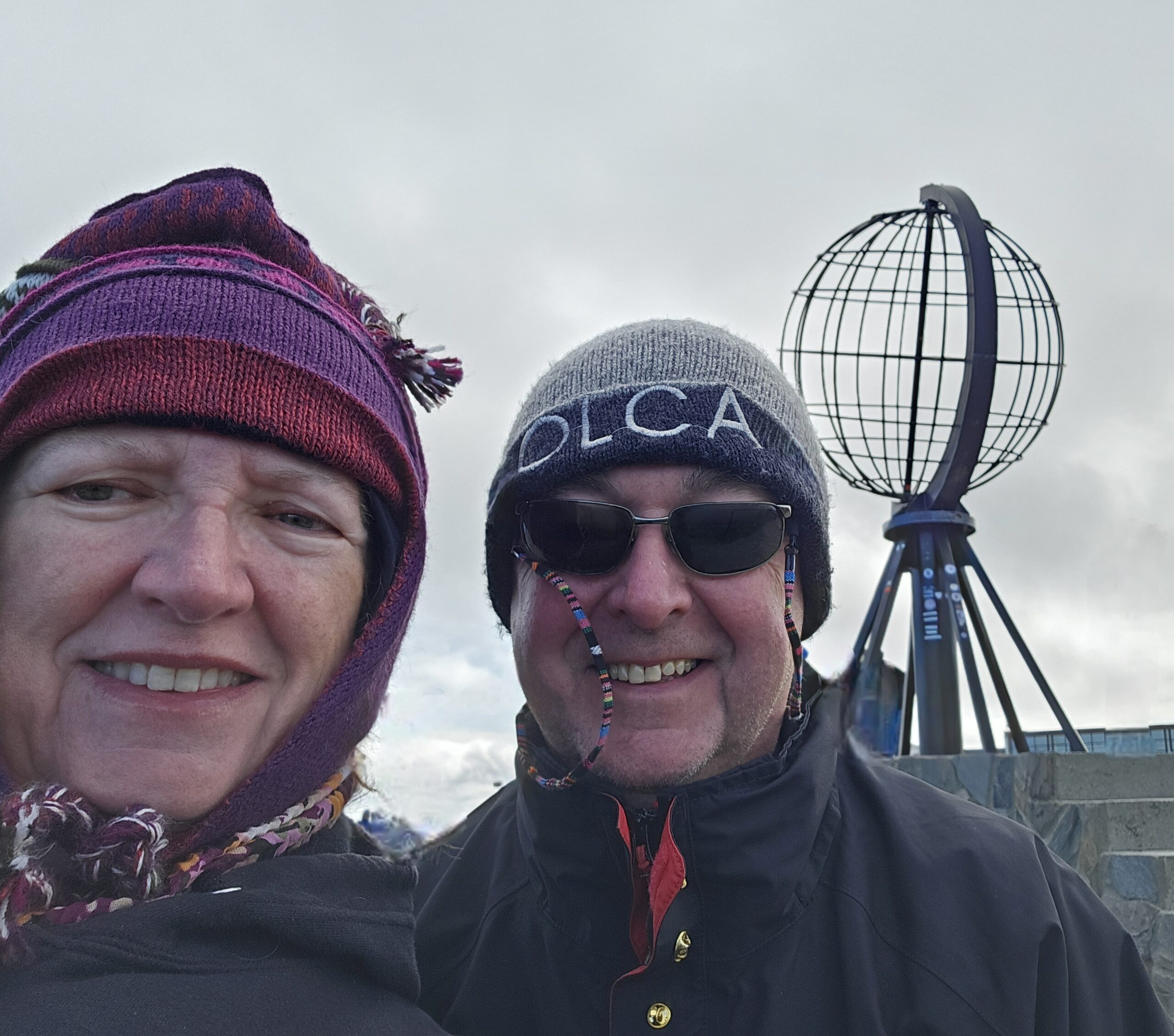
Here you can stand 307 m (1007 ft) above sea level, watching the Atlantic Ocean colliding with the Arctic Ocean, where you can see the metal globe artwork. Built in 1978, the globe’s steel structure made up of rings which depict the actual lines of latitude and longitude, placed on an axis that is aligned parallel to Earth’s axis, represents a global meeting point.
Obviously we had our photos taken to show we had been there, whilst overcoming the biting wind, despite the many layers.
There is a huge Visitor Centre with the biggest Gift Shop I have seen in a long time! Saw a good film about the area and it’s scenery, visited the Thai Chapel and Cave of Lights.O
Outside the front was The Children of the World Monument designed in 1989 by seven children from various parts of the world, which symbolises “friendship, hope and happiness’ across borders.